Design
This document describes the general design ideas behind sesam.
Some familiarity is assumed, i.e. the other chapters of this manual
should have been read and ideally the reader also tried sesam.
General concepts
Short overview
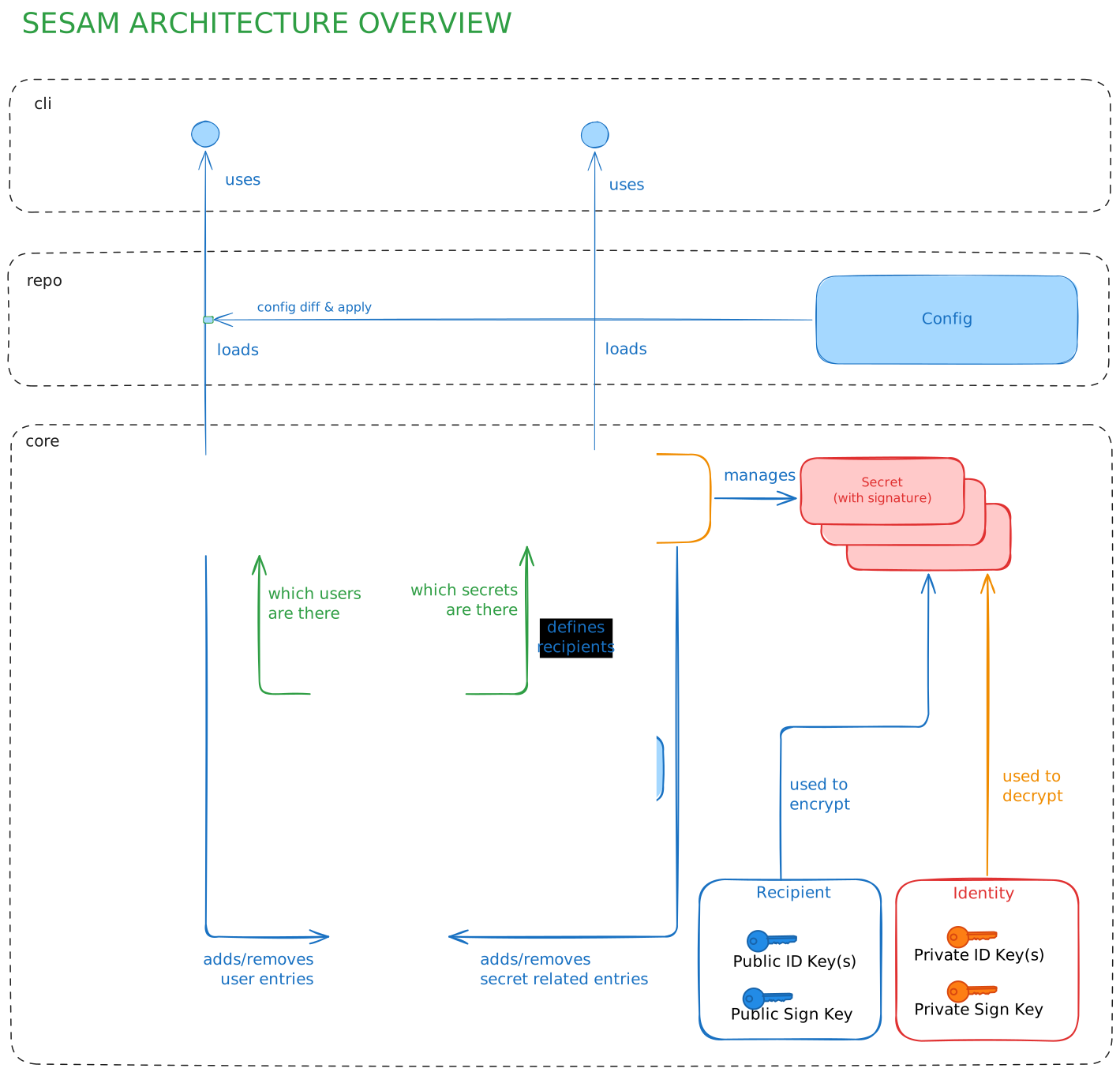
This is a very brief summary of what components we have.
- secret: A single age-encrypted file with a footer that can be decrypted by all configured recipients.
- footer: Each sealed file has a footer storing the revealed path, ciphertext hash, HMAC content hash, recipients hash, sealer, and signature.
- repo: The place where
sesamstores its state (i.e..sesam/). That's the main part you want to commit. - recipient: A public key attached to a user, required for decryption (terminology copied from
age). - identity: The private key used by users, required for decryption (terminology copied from
age). - audit log: A log that keeps track of what file operations were done on the repository. It is signed and append-only, so that tampering would be immediately detected. By replaying the log we can derive the verified state.
- verified state: The state that we expect in the repository. Contains information about all users, groups and secrets.
- config: The
sesam.ymlfile(s) on disk. They may diverge from what the verified state describes. If this is the case,sesam config diffwill show the differences. We call this the desired state. - keyring: When rebuilding the application from the audit-log we collect all public keys of all users in this structure.
- signkey: Each user has a private signature key only he can read. We store those age-encrypted in the repo.
- user: Users are user IDs that have a signkey, one or more identities, one or more recipients, and membership in one or more groups.
Design guidelines
Those are a couple of rough directions we try to adhere when modifying sesam.
gitintegration is important. We don't support other version control systems, and usingsesamoutside of agitrepository might be possible, but definitely way less powerful.- If possible, all state should be in
.sesamand all state should be as small as possible. - Revealed files and encrypted files should be two different places. Tools like
ageboxandgit-cryptflipping around between them (even withsmudgefilter) never works well in the end. - Where possible we re-use well regarded projects and standards like SSH and age. Use what developers (i.e. users) already have.
- The revealed files are a subset of the files that are sealed. Not all users can reveal all files. Keep that in mind.
- Private key handling should be in the control of the user. There are so many ways to provide a key, we just need to optimize for the most common ones.
sesamshould support several.sesamdirs per git repo,.gitand.sesamdon't need to be in the same folder.- We use multicode to encode hashes, priv/pub keys and signatures in a self-describing way.
Why age and ssh?
Most existing tools seem to rely on OpenGPG or symmetric keys for encryption. We never particularly enjoyed using PGP, although it is a feature-rich solution. In our experience it broke rather often and is really awkward to use for machine users.
sesam is mainly (but not exclusively) a tool from developers for developers.
Many developers are familiar with ssh as a daily driver of their work. Most people using GitHub or any other popular forges use it to authenticate themselves to the service. Meaning: They already have a key they could use for sesam. Also forges give us a big public key directory that we can use right away.
ssh itself is meant for networking; we were only interested in the
key concept. Luckily age exists, which not only supports ssh keys
for hybrid encryption but also provides a clean encryption format and
post-quantum keys.
Additionally age offers a full plugin
system, making extending
sesam with new ways of authenticating (e.g. FIDO keys) easier.
Why not a clean/smudge filter?
The obvious git-native approach would be a clean/smudge filter à la git-crypt:
track the secret at its real path, encrypt on git add, decrypt on checkout,
and let the ciphertext live only as a blob in .git/objects. We deliberately
don't do this. sesam keeps the ciphertext as a real file under
.sesam/objects/ and owns those bytes end to end.
-
age is non-deterministic, on purpose: Every seal produces fresh ciphertext (and a fresh footer signature over it), which hides which secret changed. A clean filter is expected to be roughly deterministic.
gitcomparesclean(worktree)against the stored blob to decide if a file changed. Non-deterministic clean output means every checkout, stash oradd -Acan mark unchanged secrets as modified, causing spurious re-encrypts and history churn. We are not alone alone on that view either. -
The current layout is fail-safe; a filter fails open: In our model the plaintext paths are gitignored and only ciphertext objects are tracked, so committing a plaintext secret is very hard. With a filter the plaintext path is the tracked file, and "don't leak plaintext" rests entirely on the filter actually running. A fresh clone without sesam configured, or a filter that breaks silently could commit plaintext without the user realizing.
-
Leveled access does not fit the filter model: Not every user can decrypt every secret. With separate ciphertext/plaintext files this is trivial: a user reveals only what they can, and the rest stay as ciphertext objects with no plaintext pendant. A smudge filter would have to pass undecryptable ciphertext straight into the real path, so a user's worktree becomes a mix of plaintext and ciphertext files that are indistinguishable by name. Not writing revealed paths we don't have access to is no option either, as those would be counted as deleted by
giton the nextgit add. -
Atomicity: git gives us atomic blobs, index and ref updates, but our invariant spans several files (secrets ↔ audit-log root hash ↔ signkeys).
gitcan't express that transaction; our.sesam-tmpstaging swap can. A filter would split the write across git's index and our pre-commit hook, leaving a window where sealed blobs are staged with no matching audit entry. -
We want to stay mostly decoupled from git. What we want is to integrate with
git, not fully depend on it. If we would ever extend support to other VCS then having a hard dependency on clean/smudge we would have a hard time migrating. The existing integrations tie nicely into the core model ofsesam, which is independent of any VCS. Having our own layout also gives us some freedom to change.
In short: clean/smudge is a nice idea, but was not really build with encryption in mind.
Two state representations
sesam operates on two different views of the repository:
sesam.yml- the declared state. Edited by humans. Describes who should be in which group and which secrets exist.- The audit log under
.sesam/audit/log.jsonl- the verified state. Append-only, signed, replayed to derive the actual current state.
sesam apply is the bridge between them: it diffs the two and proposes
audit-log entries to bring the verified state in line with the declared
state. Verification always operates on the audit log; the declared
state is treated as a request, never as truth. This is what makes the
Invalid modified config attack (see below) recoverable.
Persistence
sesam will store all its data inside the .sesam directory. This directory may be in the
same directory as a .git folder or inside a subdirectory of a git repository.
sesam.yml
.gitattributes
.gitignore
.sesam
├── audit
│   ├── init
│   └── log.jsonl
├── objects
│   ├── some_folder
│   │   └── secret.sesam
│   └── README.md.sesam
├── signkeys
│   ├── user1.age
│   └── user2.age
└── tmp
sesam.yml
The config file describing the desired state. Read more on the Config page.
.gitignore
Written on sesam init. Will by default block all files except the ones visible in the tree above.
This is to make sure that you do not commit revealed files by accident. If you have extra files
you want to commit then you can of course add them here.
.gitattributes
Written on sesam init. Defines the git integration of sesam.
objects
The files in the objects folder are named the same way as their revealed pendants, just under a different root (.sesam/objects).
The .sesam format is age but with an added footer at the end.
The footer is limited to 4KB and is delimited by a newline. This makes obtaining an age compatible file easy:
head -n -1 .sesam/objects/secret.sesam > secret.age
The header contains this information encoded as a single JSON line:
{
  "path": "secret.txt",
  "cipher_text_hash": "FiB0eH3drhYns5xqSy2sXINndqwUgyShJXL2u+zOWtqouQ==",
  "hmac_content_hash": "FiCVsGLjTYYH7ECkxR3Kou4cx1drQ+3EjDnhHQMLLU+I8g==",
  "recipients_hash": "FiBhMoSClLQvUewkfIPU9Rl0lE1UCCxt2aHUS/uQofv21A==",
  "signature": "7aEDQKhzZ4EDbFoMaTC0UtSaKzt8axfBEcR5UAlHbyZM+DGA/qL72oUXq5cPOvMBeQ6IyUI8sfqnVOa2F1XQx/a9jgM=",
  "sealed_by": "user",
  "version": 1
}
- The hash used is
sha3-256 - The signature used is
ed25519using the sealer's signing key. recipients_hashis an order-independentsha3-256over the recipients' public keys. It lets an incremental seal detect a changed recipient set (e.g. a user told into a group) without decrypting the object. It is folded into the signed payload alongside the content hashes, so a forged hash is rejected on verify.hmac_content_hash: Is the content hash as HMAC using the file's age encryption key.cipher_text_hash: Is the hash of the encrypted content.- On reveal,
sealed_byis checked against the access list ofpathin the verified state. A signature is rejected if its sealer has no current access to the secret, even when the signature is cryptographically valid.
audit log
init
The init file is written once per sesam init. You may never modify it,
as we check if it was modified over the course of the git repo's lifetime.
It contains an UUID generated during init.
log.jsonl
The encoding of the audit log. See Audit log Specifics for the entry schema.
- First line is the base64 encoded, age-encrypted audit-key log.
- This first line will change when adding new users or removing existing ones.
- Every other line is a base64 encoded audit entry.
- Each entry is encoded as JSON and then encrypted with the symmetric key from line1 with
XChaCha20Poly1305. - Each entry carries its own random nonce as a prefix.
- The
seq_idis the entry's associated data, so a line moved within the log fails to decrypt. - Anyone who can decrypt line 1 can decrypt the entire log. In practice
this means every currently-active user. After a
kill, the symmetric key is rotated and line 1 is rewritten - but a removed user who already pulled retains the ability to decrypt log entries up to the rotation point.
signkeys
Each user possesses an Ed25519 signing key, generated during sesam init or
adding of that user. The private key part is stored in this directory under the
user's name. It is encrypted using age. Each signing key is only accessible
via the identity of that specific user.
Why separate signkeys? Because regular age keys do not allow signing, while ssh keys do. To allow both (and possibly more in the future) we coupled the identity to a separately managed signing key.
A user who has been removed via sesam kill retains their old
signkeys/<user>.age file in git history, and can still recover the
private key with their identity. They can therefore still produce
ed25519 signatures with their old key. This is harmless because their
signing public key is no longer in the active state derived from the
audit log, so any signature they produce will be rejected at verify
time.
tmp
We use our own tmp folder to make sure sensitive information is not stored
outside .sesam. This also gives us the guarantee (well, if the user is not
really doing weird stuff) that we're on the same partition, which makes
renaming files atomically easier.
Cryptography
Short facts
- Two kinds of keys: signing (ed25519) + identity/recipient (ssh or age)
- Hybrid encryption using
age(X25519) and an additional signature. - Audit log proving who added which user or secret at what time.
- Audit log is encrypted to avoid spilling too much information.
- Secrets are linked to the audit log by storing a root hash, built out of the individual hashes of all current secrets.
- Only admin users can add or remove users.
- Only users with access to a secret can give access to other users.
Threat model
sesam protects against the following threats:
| Threat | In scope | Mitigated by |
|---|---|---|
| Read-only attacker on the git remote | Yes | age hybrid encryption of all files in .sesam/objects |
| Repo-write collaborator self-elevating to admin | Yes | New audit entries must be signed by an admin already pinned |
| Repo-write collaborator adding self to a secret's reveal list | Yes | Same - must be signed by an existing recipient |
| Audit log truncation / substitution | Yes | Init-file pin + prefix check across git history (see below) |
| Repo-write collaborator pushing broken state (DoS) | Partial | sesam verify flags it, but the repo state needs to be reverted |
| Compromise of forge public-key directory (e.g. github:user) | Partial | Resolved keys + alias pinned in audit log (TOFU); manual exchange is safer |
| Force-push that rewrites history | Out of scope | User must disable force-push at the forge |
| Local machine compromise / identity-key extraction | Out of scope | User responsibility (e.g. encrypted fs) |
| Removed user reading secrets they previously had access to | Out of scope | Requires explicit rotate; see Confidentiality section |
Social engineering of an admin (e.g. sesam tell attacker) | Out of scope | - |
Aspects
A cryptosystem needs to fulfill different aspects which we try to describe here.
Confidentiality - data is only disclosed to authorized parties
This is guaranteed by age. Only encrypted files in .sesam/objects are pushed.
Using hybrid encryption, only the recipients defined at seal time can
decrypt the file.
If a user is added we will re-encrypt the files to include the user accordingly to all files he has access to. When removing a user we have to consider all secrets known the user had access to. Future secrets will not include him/her as recipient, but a rotation of secrets is required.
Removing a user does not revoke access to secrets they could previously read. Two reasons:
- The encrypted ciphertexts they already pulled are still decryptable with their identity key, forever.
- Past commits in git history still contain those ciphertexts encrypted to their old recipient.
To actually revoke access, follow sesam kill with sesam rotate for
every secret the user could read. This is a property of any
secret store - not unique to sesam.
Integrity - data is not modified in unauthorized ways
Both the audit log and the actual secret files have signatures attached to them.
The audit log's signatures are verified on most commands (seal, tell, kill, ...) but not all
(sesam show for git diff textconv is intentionally lightweight for UI/UX purposes).
Full integrity check is being done on revealing the secrets or when doing sesam verify --all.
This includes checking that the user named in sealed_by has access to the secret
according to the verified state. sesam show (git diff textconv) skips this check
by design. Run sesam verify --all for the authoritative result before trusting a
value.
Availability - data/systems are accessible when needed
This can be split in two parts: Repository availability and Secret availability.
Since sesam is not a long running process, repository availability is mostly the same as in every
git repository. You can always clone a repo and retrieve the encrypted files in it as long the remote is available.
Secret availability means that we have to make the secrets available when needed (e.g. for deployments).
The stronger the verification is the more likely it is that deployments will fail to run because we found
something suspicious. As a user you can choose between fast reveals (more availability - just
git pull plus the smudge filter) and high integrity (additionally
running sesam verify --all, or using sesam reveal --pull).
The best solution of both worlds is to set up a job in CI that tells you when a sesam repo does not verify correctly anymore and act accordingly before you go to deployment.
Authenticity - the entity is who it claims to be
This is guaranteed by having an intact audit log. Every user has a public signing key that is stored in the audit log when the user was created. All signatures made by this user can therefore be verified to be authentic by all other users.
Non-repudiation - a party cannot later deny an action they took
The audit log is append-only by design. Replacement and truncation are not prevented at the storage layer, but they are detectable:
- Replacement is caught because the init UUID and signature in
.sesam/audit/initare pinned in the first commit and checked over git history. - Truncation is caught by verifying that the audit log at each prior commit is a strict prefix of the log at the next - i.e. the log never shrinks across history.
Caveat: This only holds true when force pushes are not allowed or at least noticed.
Accountability - actions can be traced to a responsible party
Entries in the audit log have a user name attached to them.
Reliability - consistent intended behavior
Reliability here means crash-safety, not determinism. Given the same
inputs, sesam seal produces different ciphertext on purpose
(inherited from age). This makes it harder for a read-only attacker
to identify which secret changed between two commits.
On the other side we do the following things to stay reliable in case of crashes:
- We use atomic renames where possible to avoid half-written files and inconsistent state.
For larger operations we have a staging tree at
.sesam-tmpwhere all operations need to succeed before we swap it back with the main state. - We use file locking to avoid having several processes working on the repo.
- The audit log can detect logic failures.
Assumptions
We assume a few things about our environment that are hopefully not fully unreasonable:
- The git history is linear, i.e. we can detect if someone tampered with the audit log. This means
git push --forcemay not be allowed. This can be easily disabled by most forges and is usually the better default for most use cases anyways. - Users having write access to the repository have a certain level of trust. If malicious, they might not be able to read secrets, but it
might be possible to cause outages by pushing broken secrets that make
sesam verifyor other commands complain. - Some local operations (like viewing diffs or doing an checkout of old branches) do not require full verification on every step. We assume the user
regularly runs
sesam verify --all(e.g. during CI/CD) before doing anything serious like deployment. - User identities are stored securely and are not shared between users.
Attack vectors
In this section we collect attack vectors we are protecting users of sesam from.
Replacing secrets with attacker supplied content
Signatures protect the integrity of a secret, but what if the signature is replaced as well?
- If the attacker does not add an entry to the audit log, then we will notice because the
root_hashchanged. - If the attacker tries to add an audit entry then he has no way to sign it if he is not already part of the repository.
- If the attacker is part of the repository but cannot access this specific secret, the file's footer will name them in
sealed_by. Onsesam revealandsesam verify --allwe check thatsealed_byis in the secret's access list and reject the file otherwise.sesam showand the git diff/smudge integration skip this check by design. - If the attacker already had legitimate access to the secret then this is out of scope for
sesam.
Self-add to reveal list or admin list
Similar, what stops an attacker from adding himself to the access list for a secret or make himself an admin?
For admins: Only admin users can add new users or change groups. A user might be part of the repository and can therefore append an entry with valid signature to the audit entry. However, the signature must be from an admin user that was an admin already before that entry.
Similarly, users cannot add themselves to the access list for specific secrets. We check that the user changing the access list had access to the secret beforehand.
Audit log substitution or truncation
One could try to substitute all of the audit log to tell another story about the repository's state. Alternatively, one could truncate the audit log to a state that is more favorable for the attacker.
There are two mechanisms that can detect such:
- The first entry of the log has a hash which is stored separately in
.sesam/audit/init. This file should never change over git history. We verify that git history contains only one committed content for it and that the on-disk file matches that committed content. During verification we compare this stored hash to the hash of the first audit-log entry. This test catches complete log substitution. - A more thorough test is to check if the audit log is only growing. Since it's append only we would notice truncations by going back in history and seeing if each commit contains an audit log that is an prefix to the audit log in the commit afterwards. This test is too expensive to be run all the time but will also notice if the log was truncated.
Denial of Service via broken repo
Someone could do some of the things above unsuccessfully and still push it. The result might be a broken audit log or
secrets with wrong signatures or hash values. In any case, sesam verify will complain - which is the right thing to do here.
But this will also lead to secrets not being revealed. If sesam is part of a deployment pipeline we have to rely on the user
stopping the deployment and checking what's up before potentially deploying old secrets (causing trouble later on).
Invalid modified config
The audit log describes the current state of the repo, while the config (sesam.yml) describes the state the repository should have.
This could be hijacked though by an attacker pushing a modified config with the changes he or she would like to see and then convince or trick
another privileged user (e.g. an admin) to then call sesam apply to change the state accordingly. It is a rule therefore to allow for sesam apply
to only apply the changes if they are present as git diff in the current working directory. When the change came already committed, then
apply and verify will complain. There are situations where this could be valid though, which is why you can force apply to do it anyways.
Supply chain attacks
A very hard thing to mitigate. We don't do very well here yet.
- We try to use only few, trusted and well established libraries.
- We use
govulncheckto stay informed about know vulns. - Release checksums are signed to at least avoid binary based supply chain attacks.
Possible improvements
- Using forge-ids or links as public key input has transparency issues:
the resolved key material is pinned into the audit log on
tell(TOFU), but the first resolution still trusts the forge. Surface a clear summary of which user/public keys are about to be recorded before signing the audit entry, and document that side-channel exchange is safer when high assurance is required.
Implementation
Audit log Specifics
Append-only, hash-chained and signed log of all state-changing operations.
Stored under .sesam/audit/log.jsonl.
Entry structure:
| Field | Description |
|---|---|
seq_id | Monotonic sequence number (starting at 1) |
prev_hash | SHA3-256 (multihash-encoded) of the previous entry |
operation | Operation type (see below) |
time | ISO8601 UTC timestamp |
changed_by | User that executed the operation |
detail | Operation-specific data (see below) |
signature | Ed25519 signature over all other fields (canonical JSON) |
Operation types:
| Operation | Detail fields | Notes |
|---|---|---|
init | InitUUID, Admin (embedded UserTell) | Trust root. Pins the first admin. See below. |
user.tell | User, PubKeys, SignPubKeys, Groups | Add a user. Must be signed by an admin. |
user.kill | User | Must not remove the last user or last admin. |
user.rename | OldName, NewName | May not rename to an existing user. |
user.change_groups | User, NewGroups | Replace a user's group membership. |
user.add_recipients | User, PubKeys | Add age recipient key(s) to a user. |
user.rm_recipients | User, PubKeys | Remove age recipient key(s) from a user. |
user.regenerate_sign_key | User, NewSignPubKey | Rotate a user's signing key. |
secret.add | RevealedPath, AccessGroups | Add a new secret and its access list. |
secret.change_access | RevealedPath, AccessGroups | Change an existing secret's access list. |
secret.move | OldRevealedPath, NewRevealedPath | Rename or move a secret. |
secret.remove | RevealedPath | Only users with access may remove. |
seal | RootHash, FilesSealed | Hash over all sorted signatures. |
Initial group membership is part of the user.tell detail; later changes go
through user.change_groups. Admin status is determined by membership in the
"admin" group.